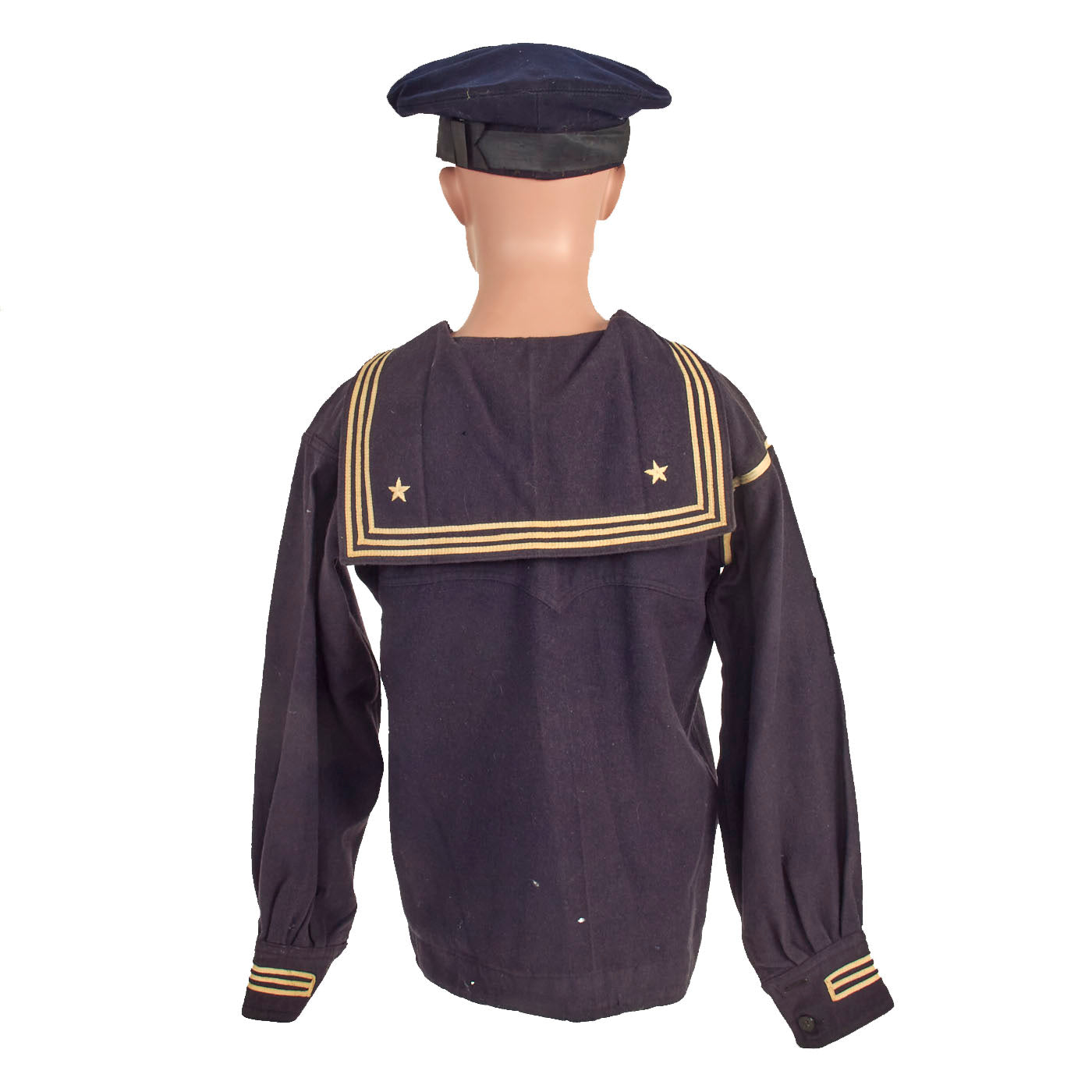
us navy dress blue uniform Original U.S. WWI US Navy Gunners Mate Service Dress Blue Uniform Set –  International Military Antiques
SKU: 25290299472
us navy dress blue uniform

us navy dress blue uniform Original U.S. WWI US Navy Gunners Mate Service Dress Blue Uniform Set – International Military Antiques

Sale price$23.30 Regular price$25.89
Save 10%
Size: 4

Pay in installments of $6.47 with ShopPay, AfterPay and Klarna

Shipping Estimate
USA
  • USA
  • CAN

Ships within 48 hours · Estimated delivery Jun 29 - Jul 4

Promo Codes Available:

For Your Every Summer RSVP, with Code: SUMMER15

Description

us navy dress blue uniform Original U.S. WWI US Navy Gunners Mate Service Dress Blue Uniform Set – International Military AntiquesOriginal Items: Only One Set Available. The US Navy dress blues have been in service for over 150 years and are still worn today. On a couple of occasions the Navy tried to replace the uniform. First, in the mid 40s, an "Ike" style uniform featuring a short jacket was tried out and was soundly rejected after its trial period. Then, between 1973 and 1980 the uniform was, in fact, briefly replaced with a more contemporary suit and visor cap design only

 Original Items: Only One Set Available. The US Navy dress blues have been in service for over 150 years and are still worn today. On a couple of occasions the Navy tried to replace the uniform. First, in the mid-40s, an "Ike" style uniform featuring a short jacket was tried out and was soundly rejected after its trial period. Then, between 1973 and 1980 the uniform was, in fact, briefly replaced with a more contemporary suit and visor cap design only to return to the tried-and-true dress blues. The uniform's main qualities of comfort, practicality, and a distinctive design have endeared it to the sailor. Iconic in appearance, the primary WW2 dress blue outfit consisted of a beret style cap with a ribbon and bow around the band; a "V" neck jumper with a square sailor's collar; a silk neckerchief; and bellbottom trousers with a 13-button broadfall front. Although its design features evolved from needs that had long since passed into history and were archaic even by WW2 standards, the uniform provided the sailor with an instantly recognizable uniform that boosted morale, evoked esprit de corps, and honored the Navy's proud history.

Photos dating back to at least the early 1860s show US sailors wearing a blue wool uniform not too different from the WW2 design. Through much of its early years the uniform was worn at sea, but by WW2 it had become mainly a dress uniform used for more formal occasions such as in formations, ceremonial activities, or for special guard duty. It was also worn on shore leave in appropriate climates. In fact, during WW2 it is most often seen being worn in northern shore and training stations by new recruits. The shift from a practical working uniform to one used for dress occasions was inevitable as military doctrine was evolving during the 1930s and 40s by setting specific roles for uniforms and establishing clear distinctions between work, garrison, and combat attire. And by the end of WW2 the age of multi-use uniforms had passed.

The dress blue jumper and trouser combination was considered a winter uniform to be worn in cool temperatures. It was constructed of high quality 16-ounce Melton wool that had a fine nap and was relatively soft to the touch. There were appropriate accessories to keep sailors warm on colder days. These included an overcoat made of matching heavy-weight Melton, blue wool knit gloves, and a blue wool muffler. The Dress Blue Uniform was included as part of the enlisted man's initial clothing gratuity. In northern training stations it was issued at induction and in warmer areas not until graduation was complete and final assignment received.

The dress blue uniform underwent continuous refinement over the decades of its use as was typically the case with uniforms that existed for any length of time. This process continued during WW2 with some significant changes being made to the jumper and trousers at the end of 1943. At this time it was decided to shorten the length of the jumper by six inches and simplify the waistband area of the trousers. These changes were implemented primarily to realize savings in a wartime economy by reducing the amount of fabric required to make the uniform and to speed up production by simplifying the manufacturing process.

The Dress Blue Uniform Items In This Grouping:
- Patched Gunner’s Mate Jumper and Trousers: The Gunner's Mate rating is primarily surface warfare-based. Closely associated Naval occupational ratings are Fire Controlman (FC), Aviation Ordnanceman (AO), Missile Technician (MT), Mineman (MN). The Gunner's Mate rating is one of the original ratings created as a result of the Naval Armament Act of 1794. The others include Boatswain's Mate (BM), Quartermasters (QM), Master-at-Arms (MA), and Yeoman (YN). The rating is also among the top five source ratings for enlisted Naval Special Warfare candidates.

The left breast features a single pinned on ribbon for the WWI Victory Medal, in wonderful condition. The right upper sleeve has a strange combination “dual rated” type of patch. The rate insignia is what appears to be a Gunner’s Mate as well as a Quartermaster, one we have not encountered before! The right shoulder has a white branch mark present. Enlisted men below the rank of petty officer wore stripes around the shoulder of their dress blue jumpers called Branch Marks. These stripes were made of ⅜-inch-wide white or red braid. Men assigned to the Seaman Branch wore a white braid on the right shoulder and men assigned to the Artificer Branch (Engine Room Force) wore a red braid on the left shoulder. Branch Marks were worn until the rank of Petty Officer was achieved, after which a Rating Badge was worn on the sleeve of the jumper. The cuff stripes indicate the rank of a Seaman 1st Class. Both the trousers and jumper are in good condition with minor moth nips and no significant damage.

- Pre-1933 USS Yorktown Flat Cap: The blue cloth cap was remarkable for its longevity having served as an essential part of the enlisted sailor's uniform for over one hundred years. During its considerable time in service, the blue cap sailed on frigates, sloops, paddle wheels, submarines, battleships, and aircraft carriers. It was present for the transition from sails to steam to fuel oil, and even lived to see the advent of nuclear propulsion. But perhaps, most of all, the cap brings back memories of great armadas, the age of Dreadnoughts, and the historic conflicts they partook in. Recorded in the Navy Uniform Regulations as early as 1833, the blue cap was originally part of an ensemble of clothing prescribed for enlisted seamen to be worn outdoors in both cold and warm weather. Early regulations simply described a "Blue Cloth Cap" until the Civil War period when the wording was slightly changed to "Blue Cloth Cap, without visor".

The circumference of the pre-1933 cap was much larger and required a wire stiffener on the inside to help keep its shape. Just like a lot of other sailors, the stiffener was removed to attribute a saltier appearance. The 1933 cap had a front riser that lifted the crown well above the ribbon. Additionally, the crown of the 1933 cap was attached to the sides using a cord seam, which is not present on this one. Prior to 1941, the vessel's name or any one of a number of different shore station designations could be displayed on the ribbon. In this case it's the Gunboat USS Yorktown (PG-1). The cap is in lovely condition and is even named on the inside with H. H. EDMAN stenciled into the top lining. Unfortunately we have not been able to locate any service information, making for a wonderful research opportunity.

This is truly a wonderful set of an early US Navy Dress Blue Uniform with a ship tallied flat cap! Comes more than ready for research and display.

Approx. Measurements:
Collar to shoulder: 9.5”
Shoulder to sleeve: 20”
Shoulder to shoulder: 17.5”
Chest width: 17.5”
Waist width: 18”
Hip width: 18”
Front length: 23.5"

Pants:
Waist:15.5"
Inseam: 28"

USS Yorktown (PG-1)
USS Yorktown was the lead ship of her class of steel-hulled, twin-screw gunboats in the United States Navy in the late 19th and early 20th centuries. She was the second U.S. Navy ship named in honor of the American Revolutionary War's Battle of Yorktown.

Yorktown was laid down by William Cramp & Sons of Philadelphia in May 1887 and launched in April 1888. She was just over 244 feet (74 m) long and 36 feet (11 m) abeam, and displaced 1,710 long tons (1,740 t). She was equipped with two steam engines which were supplemented with three schooner-rigged masts. The ship's main battery consisted of six 6-inch (15.2 cm) guns and was augmented by an assortment of smaller-caliber guns.

At launch, Yorktown joined the Squadron of Evolution of "New Navy" steel-hulled ships. Detached from that squadron, Yorktown, under the command of Robley D. Evans, sailed to Valparaíso, Chile, during the 1891 Baltimore Crisis and relieved USS Baltimore at that port. After that situation was resolved, Yorktown took part in the joint British–American sealing patrol in Alaskan waters and duty on the Asiatic Station before returning to the United States in 1898. Yorktown was out of commission during the Spanish–American War, but took part in actions in the Philippine–American War and the Boxer Rebellion in 1899 and 1900, respectively, after she had been recommissioned.

After three years out of commission from 1903 to 1906, Yorktown hosted the Secretary of the Navy on board when he greeted the Great White Fleet on its arrival in San Francisco in May 1908. Over the next five years, most of Yorktown's time was spent in sealing patrols in Alaska and duty in Latin American ports. From July 1912, Yorktown was out of commission for alterations, but resumed duties off the Mexican, Nicaraguan, and Honduran coasts beginning in April 1913. Through World War I, Yorktown continued in the same role, until she departed for the East Coast of the United States in April 1918. She served as an escort for one convoy headed to Halifax in August, and remained in coastal escort duties in the east until January 1919. After arrival at San Diego in February, she was decommissioned for the final time in June 1919, and was assigned the hull number PG-1 the following year. She was sold in 1921 to an Oakland, California firm and broke up that same year.

Recommissioned on 1 April 1913, with Commander George B. Bradshaw in command, Yorktown operated out of San Diego on shakedown into mid-April. She was soon back at Corinto, however, remaining in Nicaragua until 5 June. After a brief period of operations off the coast, she returned to Corinto on 21 June and remained there for over a month before departing on 31 July to coal at Salina Cruz, Mexico. She moved to Mazatlán on 10 August and there picked up mail, delivering it to the port of Topolobampo, Mexico, on the 11th. Yorktown remained there until mid-September.

For the remainder of 1913, Yorktown conducted local operations out of San Diego and San Francisco. In January 1914, though, the gunboat returned to Mexican waters and investigated local conditions at Ensenada between 3 and 6 January before moving, in subsequent months, to a succession of Mexican ports: Mazatlán, San Blas, Miramar, Topolobampo, and La Paz. Following an overhaul at Mare Island from 24 June to 2 September 1914, Yorktown served in Mexican waters again into June 1915. From that point until the entry of the United States into World War I in April 1917, Yorktown continued her routine of patrols off Mexican, Nicaraguan, and Honduran ports with occasional repairs at Mare Island and maneuvers out of San Diego.

After the United States joined the Allies, Yorktown operated off the coast of Mexico until August 1917, when she paused briefly at San Diego. On 18 July 1917, Yorktown rescued the last surviving members of an abandoned guano mining settlement on Clipperton Island. From a peak population of roughly 100 in 1915, only four women and seven children survived. After her time off the Mexican coast, Yorktown then cruised off the west coasts of Central and South America into 1918. After a refit at Mare Island, Yorktown, sailed for the east coast on 28 April 1918, transiting the Panama Canal en route, and arrived at New York on 20 August. The gunboat escorted a coastal convoy to Halifax, soon there after before returning to New York. She performed local coastwise escort duties through the end of World War I. After a period of upkeep at the New York Navy Yard in December, she departed the east coast on 2 January 1919 on her last voyage to California.

Arriving at San Diego on 15 February 1919, Yorktown was placed out of commission at Mare Island on 12 June 1919. On 17 June 1920, she was assigned the hull number PG-1. The veteran steel-hulled gunboat was sold to the Union Hide Company of Oakland, California, on 30 September 1921; she was broken up in Oakland sometime after that.

Shipping Notes
  • Free Standard Shipping on $100+ Orders to the USA.
  • Except Preorder products are shipped in 48 hours.
  • Delivery to the USA:
  1. Standard Shipping : 3-10 business days
  • If time is of the essence, please consider selecting expedited delivery for faster service.
Exchange/Return Notes
  • We offer a 30-day return/exchange service after receiving.
  • Final sale items are not eligible for returns or exchanges.
  • To process your return/exchange, please contact us at [email protected]
  • Please click here for more details>>> Return & Exchange Policy
SKU: 25290299472

Discover Niche Categories That Outsell us navy dress blue uniform

Top-Converting Item to Boost Your Average Order

4.8 ★★★★★
Based on 1024 reviews
Sort
Highest Rating
Newest First
Oldest First
Product Reviews
M
Mark Tomlinson
Lexington, US
★★★★★ 5
This Robot Vacuum Feels Like It Came from the Year 2035 🤖🧹
I’ve looked at a lot of robot vacuums over the years, and the eufy Omni S2 honestly feels less like a vacuum cleaner and more like a tiny autonomous housekeeping system with a master’s degree in floor care. 😄 The feature list on this thing is completely ridiculous in the best possible way: * 30,000 Pa suction * self-emptying * self-cleaning mop * hot water mop washing * hot air drying * advanced obstacle recognition * intelligent mapping * fragrance diffusion * allergen filtration At this point I fully expected it to roll up beside me and politely ask whether I preferred still or sparkling water while it cleaned the kitchen. 😄 The biggest thing that impressed me is how refined and intelligent the whole system feels. This is not one of those older robot vacuums that bounces around the house like a confused hockey puck repeatedly headbutting furniture. The navigation is smooth, logical, and surprisingly efficient. It maps rooms quickly and cleans in organized patterns instead of random chaos. The HydroJet self-cleaning mop system is probably my favorite feature. One of my biggest complaints with older robot mops has always been the feeling that they were just dragging dirty water around the house. This system continuously cleans the roller mop while it works, then washes it afterward with hot water and dries it with heated air. That’s a massive upgrade over traditional robot mopping systems. The suction power is also seriously impressive. Thirty thousand Pascals is getting into “accidentally vacuumed the soul out of the area rug” territory. 😄 It handles dust, debris, and carpet cleaning more like a full-size vacuum than a typical robot cleaner. I also love the premium details: * automatic mop lifting for carpets * separate clean and dirty water tanks * advanced filtration * anti-tangle brushes * quiet operation * fragrance integration * hot-air drying to prevent musty mop smells The clean/dirty water separation especially makes the whole process feel far more sanitary and intelligently designed. Now let’s address the titanium-plated elephant in the room: this thing costs sixteen hundred dollars. 😄💸 That is a serious amount of money for a vacuum cleaner. At this price point, you begin expecting the robot to occasionally announce: > “Good evening. Sanitation protocols have been completed.” But honestly? This really does feel like a flagship-level cleaning machine rather than just another robot vacuum. The engineering, automation, and sheer number of features are genuinely impressive. If you want one of the most advanced all-in-one robot vacuum and mop systems currently available, this thing absolutely feels like the luxury-class version of robotic floor cleaning.
WAS THIS REVIEW HELPFUL?YesReportShare
Reviewed in the United States on May 11, 2026
R
Verified Purchase
Rolando Gonzalez
Carnegie, US
★★★★★ 1
Not good for marble floors
I Purchased the Eufy S2 thinking it was going to be the greatest mop because I heard it was the best but I was very disappointed how it did on my marble floors it left water stains all over my floors. The water level was to the lowest yet still it left to much water on the floor. I had better results with the New Roborock S 20 which in my opinion performed much better and the software is more advanced.
WAS THIS REVIEW HELPFUL?YesReportShare
Reviewed in the United States on May 28, 2026
R
RealTalk Ratings
Lexington, US
★★★★★ 5
Best Robot Vacuum I’ve Ever Owned – Worth Every Penny
I’ve had the eufy Robot Vacuum Omni S2 for a short time now, and I can confidently say this is one of the best purchases I’ve made in a long time. This isn’t just a robot vacuum—it’s a complete, all-in-one cleaning system that truly feels like having a professional cleaning crew built into your home. First off, the performance is incredible. The vacuuming is powerful and consistent, picking up everything from fine dust to larger debris without missing a beat. The navigation is smart and efficient—it maps your home quickly and cleans in a logical pattern instead of bouncing around randomly. You can tell right away this is a premium product designed to actually work, not just look good. Where this system really separates itself is the mopping and water management setup. The dual water tank system—with a dedicated fresh water tank and a gray water tank—is a game changer. It constantly uses clean water to mop your floors and then separates out the dirty water, so you’re never just spreading grime around. The HydroJet™ system keeps the mop clean while it’s running, and the results speak for themselves—floors come out spotless, with a true “just cleaned” feel every time. The added features take it to another level. The air freshener integration is a small touch that makes a big difference—it leaves your home smelling clean, not just looking clean. It’s those kinds of details that show how much thought went into this product. Everything works together seamlessly, from the self-emptying dustbin to the mop washing and drying system. You really don’t have to do much at all—just let it run and it handles the rest. Another thing I appreciate is how quiet and refined it is. Even with all this power, it operates smoothly without being disruptive. You can run it during the day, at night, or while you’re home without it getting in the way. And then there’s the value. Yes, it’s an investment—but when you consider everything it does, it’s absolutely worth the money. You’re saving time, effort, and honestly a lot of stress. Coming home to clean floors every day without lifting a finger is something you quickly get used to. On top of that, eufy’s customer service is top-notch. That really matters when you’re buying something like this. Knowing the company stands behind their product and is there to help if you need anything gives you extra confidence in the purchase. It feels like you’re getting not just a product, but a full support system behind it. Overall, this is a dream team in one machine—powerful vacuuming, advanced mopping, smart features, and thoughtful extras like the air freshener and dual water tanks. If you’re looking for the best of the best in home cleaning automation, this is it. Highly recommended.
WAS THIS REVIEW HELPFUL?YesReportShare
Reviewed in the United States on May 2, 2026
B
Verified Purchase
Bob Dog
Draper, US
★★★★★ 5
My house has never been so clean!
Size: 05-11S
As a neat freak, this has been one of my favorite purchases recently. Hands down. No doubt. Our house has seriously never felt so clean. With four boys coming and going, plus a cat, plus my wife and I both working out of the same house, this place gets dir-r-r-r-ty! But now, I just set this little baby up and get it goes to town. Note: the first several times that we used it, the machine's debris holding chamber was LOADED. We ran it until the battery died (and it returned to it's charger automatically), emptied it, and then ran it again as soon as it was fully charged. But each time that it ran, it was completely full! Every single time. None of us can believe how dirty we were living. Note #2: We now take it upstairs to do a deep cleaning there. We had a little bit of a learning curve to make sure that all of the electric cords and such were off the floor. (They untangle easily, btw, if you forget). My son with the cat had a room that used to smell terrible... it smells almost normal after we ran this several times through there. And the volume of cat hair that this thing picked up is crazy amazing. Hair that we didn't even see. I didn't know cat hair smalled badly, but it must've. Room smells pretty decent now (not perfect - there still is a smally boy living in there)! Note #3: We keep a pretty clean house. That is what is amazing about this thing. It makes it really clean. Note #4: After the first several runs, make sure that you clean the roller brush. It will make a difference. The tool that comes with the unit that looks like a comb does a great job. If you get hair or thread or similar wrapped around it, use the handy dandy letter opener-style cutter to easily and safely clean it out. The blue parts on bottom around roller remove easily for deep cleaning. Do it! Easy and worth it for better future results. Note #5: Does all types of floors really well. We have ceramic, vinyl, short carpet, marble, deep carpet - all on the first floor of our house --- NO PROBLEM for Eufy! It moves with ease between them all. Note #6: Problem areas? We have a screened in porch that has a door that allows tiny little leaves in under the door. I'll just set the Eufy out there and forget about it. When I see it again, the machine has run out of juice and the floor is perfectly clean. Or my basement office. Set it in there at the end of the day, close the door and forget about it. In the morning, the floors are clean and the machine is sleeping where it ran out of power. I take it back upstairs, empty the cannister, and put it back on the charger. Last note: It gets in tight spaces. It cleans edges beautifully. It spends more time on a room than we ever would, so I guess that is why it cleans so well. It gets under most of our furniture. Around most of our chairs. And oh - I almost forgot - this vacuum is SO-o-o-o quiet. With our upright, you can't hear yourself think. With this thing, I can be do my work uninterrupted. Disclaimer - I have wasted a lot of time just watching machine in amazement and awe! Thankfully I can now walk away from it - although the 7 sessions with a therapist to get me to break the habit were a pain. ;) I highly recommend the machine - if you couldn't already tell! I came back on to Amazon to buy a unit for my in-laws and saw the opportunity to avoid my job for a little bit to write this review! Funny, but I am glad that I did. This little fella is totally worth it. If you are thinking about which brand to buy, you can't go wrong with Eufy. Kudos to the manufacturer and development team! Note to manufacturer: Can you please develop a machine to automatically climb and clean stairs (cook, do toilets, do laundry)... ? People, you are going to love this vacuum!
WAS THIS REVIEW HELPFUL?YesReportShare
Reviewed in the United States on July 13, 2021
L
Verified Purchase
Lawrence Page
Boise, US
★★★★★ 5
Great robovac! We named ours “Robby the Robovac.”
Size: 06-15C Max
I hesitated for years to pull the trigger on getting a robot vacuum, and I shouldn’t have. If you are on the fence, get one. This thing has been worth the $250 in the first month, alone. (I compare it to a maid service fee.) It automates the simplest but most essential task of cleaning, because most dust and dirt ends up on the floor. It also forced me to finally tidy up all the wires and miscellaneous junk I had laying around on the floor, and thereby also eliminate areas where dust and dirt would accumulate, both of which were unexpected side benefits. It also frees up time to then wet mop and clean other places more easily, and tacitly helps me WANT to follow through with those final stages of cleaning that are easier because it takes care of the most time-intensive, initial stage of cleaning. It has been a life changer for us. The first week made the house smell a bit dusty because it kicked up all the latent dust from the corners, under furniture, and in the rugs. But once it got through that stage, the whole house looks and “feels” so much cleaner and smells nicer. Subtle but significant difference. I live in a one-story bungalow with mostly hardwoood or laminate floors, with a low-nap Berber floor covering in my master bedroom. I have a mid-size wire-hair dog who sheds normally, and it is perfect for picking up dog hair. I also have a nine year old son who adds to the dust and dirt. The suction is great on all of our surfaces. It works better than my stand-up “cyclonic” Hoover. Having three suction settings allows you to adjust the noise level depending on how clean you need the suction to be. The side brushes seem trite but definitely do work to help collect and”funnel” dirt into the collection bin. They also hit under furniture legs and walls edges to help collect the dirt that hides there. The collection bin does need to be emptied frequently (every few uses, especially when you first use it), but I look at that as letting me know what would have been on my floor if I didn’t have the unit. It is amazing how much it cleans off the floor even after the first wave of cleaning. The different cleaning modes are also well thought out: edge cleaning, spiral-spot cleaning, and random walk cleaning. I use the edge cleaning mode the most because dust and dirt tend to congregate along the edges. Three downsides that are probably fixed in higher end models. First, getting the app to work was unnecessarily frustrating and difficult because I forgot my exact WiFi password. The problem is that the interface requires you to go through about a five minute process for each “guess,” which made syncing to the app much more frustrating and unnecessarily slower than it should have been. Then with each failed attempt, I also had to also manually reset the entire unit by pressing the power button for 20 seconds. They should program it to test the password quickly so the entire syncing process does not take five minutes until you find out you typed the password incorrectly. (Especially because WiFi passwords are case-sensitive, so it is easy to mistype it). Once I typed the correct password and synced it, the problem was over, but it was frustrating and time consuming. Second, controlling the unit manually through the app is difficult because of the lag time in the signal through WiFi. So any time I manually steer the until, I use the remote and not the app. Not a big deal, but something to note. It is also too loud to schedule vacuuming at night. It woke us up the first three times it ran a scheduled overnight clean, partly because we keep our bedroom doors open at night. We are still on COVID lockdown, so I can’t just schedule it to run during the day while we are at work. So I just run it in the background during the day or when I leave to go to the store or take the dog for a walk. Nonetheless, none of those are dealbreakers, mostly just minor inconveniences that are acceptable at this price point. It still earns its five star rating for fulfilling its primary purpose and then some.
WAS THIS REVIEW HELPFUL?YesReportShare
Reviewed in the United States on June 29, 2020

recommand products