usmc dress blue bravos Original U.S. WWI Army Officer Engineer Named Painted Trunk Grouping –  International Military Antiques
SKU: 17444079491
usmc dress blue bravos

usmc dress blue bravos Original U.S. WWI Army Officer Engineer Named Painted Trunk Grouping – International Military Antiques

Sale price$19.98 Regular price$22.20
Save 10%
Size: 4

Pay in installments of $5.55 with ShopPay, AfterPay and Klarna

Shipping Estimate
USA
  • USA
  • CAN

Ships within 48 hours · Estimated delivery Jul 2 - Jul 7

Promo Codes Available:

For Your Every Summer RSVP, with Code: SUMMER15

Description

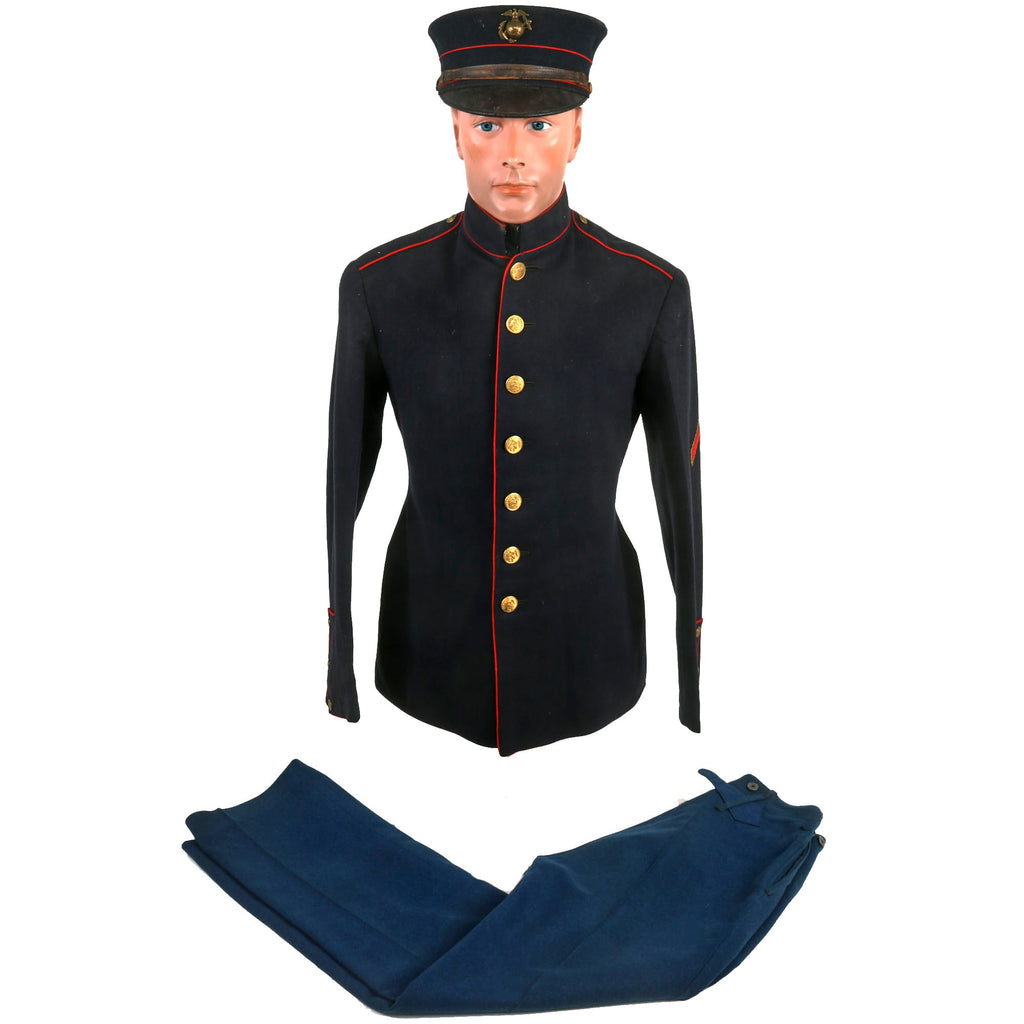
usmc dress blue bravos Original U.S. WWI Army Officer Engineer Named Painted Trunk Grouping – International Military AntiquesOriginal Item: Only One Available: This is an example of the iconic USMC M1912 Dress Blue uniform with the rare Bell Crown service cap. All buttons are retained and everything is in fantastic condition. This model of tunic and service cap are integral for any USMC or WWI US Collection. This is a full M1912 U. S. Marine Corps Uniform, including the M1912 dress tunic, dress breeches, and the dress Bell Crown service cap, named to Private John M. Powell,

Original Item: Only One Available: This is an example of the iconic USMC M1912 Dress Blue uniform with the rare Bell Crown service cap. All buttons are retained and everything is in fantastic condition. This model of tunic and service cap are integral for any USMC or WWI US Collection.

This is a full M1912 U.S. Marine Corps Uniform, including the M1912 dress tunic, dress breeches, and the dress Bell Crown service cap, named to Private John M. Powell, USMC. The tunic and pants are both near mint, in fantastic condition with one discharge chevron on the right sleeve. The pants are stenciled “J.M. POWELL” on the interior. The Bell Crown service cap has a full sweatband, partially ripped but still intact. The cap features a black leather brim, supported by pressed paper or fabric. The red piping trim was added when the 1912 model was patterned. The EGA is affixed to the front and is period correct with both latitude and longitude lines on the globe. The chinstrap is beautifully worn in a way that compliments the entire uniform. The cap has one or two tiny moth nips but is otherwise flawless on the exterior.

John M. Powell enlisted in the Marine Corps on December 12th, 1917, likely hoping to make it to France before the war was over. He was stationed at the Naval Ammunition Depot in New London, Connecticut for most of his time in the service.

Approximate Measurements:
Collar to shoulder: 10"
Shoulder to sleeve: 25”
Shoulder to shoulder: 16”
Chest width: 18"
Waist width: 17"
Hip width: 21.5"
Front length: 30.5"

Pants:
Waist: 15.5"
Inseam: 31"

The United States Marine Corps
The decades following the War of 1812 saw the Marines protecting American interests around the world, in the Caribbean, at the Falkland Islands, Sumatra and off the coast of West Africa, and also close to home in operations against the Seminole Indians in Florida.

During the Mexican War (1846-1848), Marines seized enemy seaports on both the Gulf and Pacific coasts. A battalion of Marines joined General Winfield Scott's army at Pueblo and fought all the way to the "Halls of Montezuma," Mexico City. Marines also served ashore and afloat in the Civil War (1861-1865). Although most service was with the Navy, a battalion fought at Bull Run and other units saw action with the blockading squadrons and at Cape Hatteras, New Orleans, Charleston, and Fort Fisher. The last third of the 19th century saw Marines making numerous landings throughout the world, especially in the Orient and in the Caribbean area.

Following the Spanish-American War (1898), in which Marines performed with valor in Cuba, Puerto Rico, Guam, and the Philippines, the Corps entered an era of expansion and professional development.

It saw active service in the Philippine Insurrection (1899-1902), the Boxer Rebellion in China (1900). and in numerous other nations, including Nicaragua, Panama, Cuba, Mexico, and Haiti.

Between 1900 and 1916, the Marine Corps continued its record of participation in foreign expeditions, especially in the Caribbean and Central and South America, which included Panama, Cuba, Veracruz, Haiti, Santo Domingo, and Nicaragua.

Shipping Notes
  • Free Standard Shipping on $100+ Orders to the USA.
  • Except Preorder products are shipped in 48 hours.
  • Delivery to the USA:
  1. Standard Shipping : 3-10 business days
  • If time is of the essence, please consider selecting expedited delivery for faster service.
Exchange/Return Notes
  • We offer a 30-day return/exchange service after receiving.
  • Final sale items are not eligible for returns or exchanges.
  • To process your return/exchange, please contact us at [email protected]
  • Please click here for more details>>> Return & Exchange Policy
SKU: 17444079491

Discover Niche Categories That Outsell usmc dress blue bravos

Top-Converting Item to Boost Your Average Order

4.3 ★★★★★
Based on 1965 reviews
Sort
Highest Rating
Newest First
Oldest First
Product Reviews
R
Verified Purchase
Robert and Jessica
Los Angeles, US
★★★★★ 5
How to capture the import of an entire war by writing on its end
Format: Kindle
The authors seamlessly cover ed the macro and micro accounts of events and participants to capture the stunning and all important end of WWII. I was engaged and stimulated throughout my read of this book and highly recommend it for enthusiasts who are conversant with the war and want a better understanding of its close.
WAS THIS REVIEW HELPFUL?YesReportShare
Reviewed in the United States on August 27, 2025
M
Martin Southard
Lexington, US
★★★★★ 4
World War II - The Final Months
Format: Hardcover
The book takes you through the final months of World War II, focusing on eight key moments when the fighting finally came to an end. It’s not just a dry rundown of facts or battle maps — the authors do a great job of bringing the people involved to life, from famous leaders to everyday soldiers and civilians caught in the chaos. What I really liked was how the story moves around the globe, covering Europe, the Pacific, and beyond. It keeps the narrative fresh and exciting, giving a real sense of how the war unfolded on many fronts at once. Sometimes I had to pay close attention to keep up with all the locations and characters, but that only added to the feeling of being caught up in a fast-moving, gripping story rather than a history lesson. What stood out most was how it made me feel the human side of history—the fear, the relief, and the confusion as the war finally ended. It’s full of details, but it never felt boring or too technical.
WAS THIS REVIEW HELPFUL?YesReportShare
Reviewed in the United States on October 19, 2025
C
Verified Purchase
Christian Schlect
Port Orchard, US
★★★★★ 5
The Fix
Format: Hardcover
An insightful and interesting book on how our country's first legislators try to make sense of the new and fairly short U.S. Constitution, which, being drafted by humans, was bound to be imperfect. A lack of clarity on some point might be due to the changeable nature of words themselves or to confusion or obscurity of thought by the authors. And, who were the authors? The men in the room who came up with the product or the various state conventions that approved the final product? Professor Gienapp writes well and with a fine grasp of his subject. He uses concrete examples to illustrate his main points. For example, Congressional debates over the constitutionality of a proposed federal bank, the ratification of Jay's Treaty, and even whether the Bill of Rights was to be incorporated into or simply added to the original document. Most people think of U.S. constitutional history in terms of its drafting and ratification and/or its later judicial interpretation by the Supreme Court. Here, Professor Gienapp focuses on the initial work of interpretation by the first few sessions of Congress. This book is essential reading for those interested in the U.S. Constitution and the internal architecture of our government. I think those who spend countless hours viewing frenetic talking heads say this or that about the constitutionality of some issue or another (or the nomination of a justice to the High Court) should throw their television set out the window and, instead, settle into a corner chair and calmly read this and other such thoughtful books. This one should win prizes.
WAS THIS REVIEW HELPFUL?YesReportShare
Reviewed in the United States on October 14, 2018
G
Verified Purchase
Gadavis
Omaha, US
★★★★★ 5
Excellent Book
Format: Hardcover
Stanford University History Professor Gienapp has done an outstanding job of researching and writing this historical analysis of the interpretation of the American Constitution by America's first Congress. Professor Gienapp analyzes data primarily from Congress's problems interpreting the removable of executive officers, chartering a national bank and approval of the 1794 Treaty with Great Britain negotiated by Chief Justice John Jay, the "Jay Treaty." Gienapp shows in clear writing how Congress used records of the debates at the Constitutional Convention and State Ratification Conventions to resolve these constitutional issues. I highly recommend this book to anyone concerned with the interpretation of the American Constitution.
WAS THIS REVIEW HELPFUL?YesReportShare
Reviewed in the United States on July 18, 2020
G
Verified Purchase
Gary Y. Larsen
Chelsea, US
★★★★★ 5
An analysis of how we came to think about the Constitution the way we do
Format: Kindle
It provides a detailed analysis of the arguments used to talk about the Constitution in the ten years after it was ratified. These arguments shifted from treating it as a preliminary draft to be perfected through filling in the details of the operation of the government through experience, to a sacred document that had to be interpreted to determine its "true" meaning.
WAS THIS REVIEW HELPFUL?YesReportShare
Reviewed in the United States on December 18, 2018

recommand products