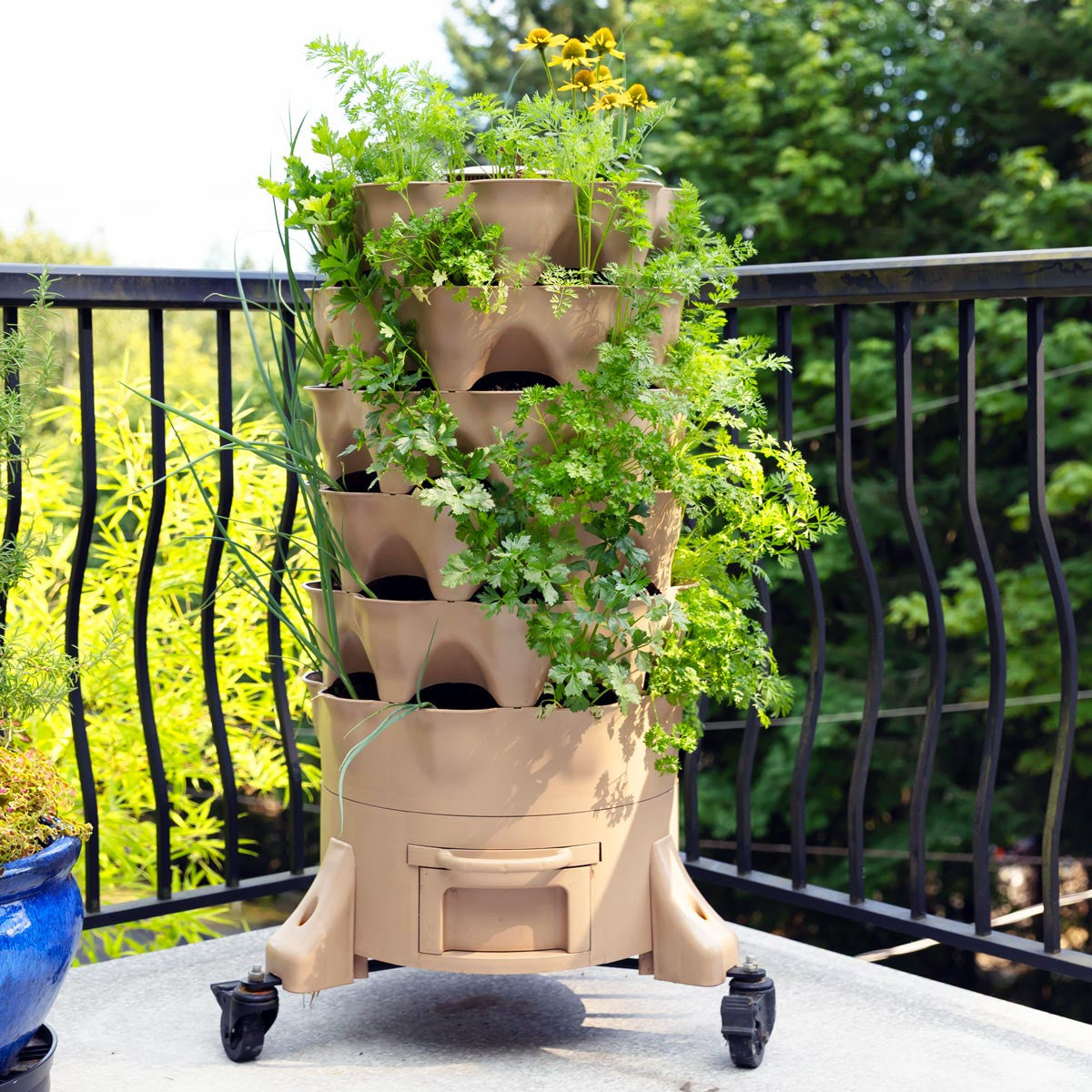
stand up garden seed planter Garden Tower 2
SKU: 91556937305
stand up garden seed planter

stand up garden seed planter Garden Tower 2

Sale price$25.73 Regular price$28.59
Save 10%

Pay in installments of $7.15 with ShopPay, AfterPay and Klarna

Shipping Estimate
USA
  • USA
  • CAN

Ships within 48 hours · Estimated delivery Jul 2 - Jul 7

Promo Codes Available:

For Your Every Summer RSVP, with Code: SUMMER15

Description

stand up garden seed planter Garden Tower 2The Garden Tower vertical garden planter and composting system replicates a natural ecosystem allowing plants to access nutrients recycled through organic composting processes. Easily grow nearly any vegetable, herb or flower organically with the Garden Tower 2! This vertical gardening system eliminates weeding, nutrient loss and most water loss associated with conventional gardening. Read more The Garden Tower 2 gives you space for 50 individual

The Garden Tower® vertical garden planter and composting system replicates a natural ecosystem allowing plants to access nutrients recycled through organic composting processes.

Easily grow nearly any vegetable, herb or flower organically with the Garden Tower 2! This vertical gardening system eliminates weeding, nutrient loss and most water loss associated with conventional gardening

Read more

The Garden Tower 2 gives you space for 50 individual plants, as well as a large vermicomposting column down the middle. This system utilizes your kitchen scraps to produce nutrient rich compost that is then made accessible to the roots of your flowers, herbs or vegetables.

The Garden Tower 2 is a great option for those looking to save space on a patio, balcony, store-front or even in a greenhouse. It's made from food-grade, USA-made HDPE (non-toxic, BPA & PVC free plastic) components, FDA-approved dye, and UV-protection antioxidant package for health, durability, and recyclability.

Features & Benefits:

  • Create organic fertilizer delivered right to your plants in one system
  • Eliminate weeding, and most water and nutrient loss
  • Made from food safe & BPA-free polyethylene
  • 50 individual spaces for different plants in just 4 square feet
  • Holds 6 cubic feet of soil
  • Rotating tower
  • Collect both the castings and "worm tea"
  • Odorless operation
  • Made in the USA
  • 3-year manufacturer's warranty

Please note the Garden Tower does not include soil, seeds, bedding material or worms. Composting worms can be purchased here, or from a variety of local and online sources.

Planting Recommendations:

Below is a shortlist of what we recommend planting in your Garden Tower!

Vegetables

Amaranth (vegetable type), Arugula, Beans, Broccoli, Brussels Sprouts, Cabbage, Cauliflower, Chard, Chicory, Collards, Cucumbers, Eggplant, Endive, Escarole, Gourds, Kale, Leeks, Lettuce, Melons, Mesclun, Mustard Greens, Dwarf Okra, Peas, Peppers, Radicchio, Sorrel, Spinach, Squash, Strawberries, Tomatoes
Note: vines such as squash and melons grow nicely from the bottom holes, trailing onto an in Tower trellis or a railing, chair, stool or piece of garden art)

Herbs

Angelica, Anise Hyssop, Basil, Calendula, Catmint, Catnip, Chamomile, Chervil, Chives, Cilantro, Dandelion, Dill, Echinacea, Feverfew, Flax, Garlic Chives, Goldenseal Hyssop, Lavender, Fennel, Lemon Balm, Marjoram, Milk Thistle, Mint, Nettle, Oregano, Parsley, Passion Flower, Pleurisy Root, Rosemary, Sage, Salad Burnet, Saltwort, Savory, Shiso, Stevia, Thyme, Valerian, Wormwood

Flowers

Edible Flowers: Calendula, Carthamus, Dianthus, Marigolds, Nasturtiums, Pansies, Salvia, Violas

Ornamental Flowers: Ageratum, Amaranth, Ammi, Aster, Bells of Ireland, Bupleurum, Morning Glory, Nigella, Petunia, Phlox, Polygonum, Poppy, Ptilotus, Rudbeckia, Safflower, Salpiglossis, Sanvitalia, Scabiosa, Snapdragon, Stock, Strawflower, Sweet Peas, Verbena, Yarrow, Zinnia

Using Your Garden Tower

The Garden Tower planter works on an aerobic (with air) composting principal, so light, fluffy soil is best. Issues can arise from over-compaction, either in the soil column or in the compost column. Straw, grass, leaves & coir are good bedding for worms and should periodically be added directly in the compost column to avoid compaction.

Start with at least 250-500 composting worms for the center compost tube. Add at least 25-50 earthworms into the soil column.

A general watering schedule during the growing season is 4-6 gallons of water every 2-3 days. That being said, this will vary for everyone, and we recommend watering with a container instead of a hose to avoid over-watering.

Every so often, once the column is full, you can empty some of the finished compost from the bottom. To do so, ensure the drawer has no water in it and pull the screen out half way to allow vermicompost to exit the bottom of the compost column, and fall into the drawer. You can use the finished compost in your gardens, and the liquid that drains down through the tower is also an ideal fertilizer.

What to Feed your Worms:

Most fruit and vegetable scraps, pulps from juicer
Cooked food
Tea leaves/bags and coffee grounds
Crushed/ground eggshells
Hair, vacuum cleaner dust, soiled paper, tissue, paper towels, shredded egg cartons
Shredded newspaper, cardboard, sawdust (untreated), wood ash
Lawn clippings in small quantities, weeds, clippings, prunings, dirt and leaves

What to Avoid or Limit:

Limit citrus and acidic fruit skin
Limit bread, pasta and other wheat based products
Avoid hard fruit pits
Avoid spice foods, onions, garlic and leeks
Avoid animal products such as meat, dairy, or fats
Avoid shiny paper
Do not feed rotten food to your worms

Taking Care of Your Worms

Worms are low maintenance and will be happy as long as they are fed, have enough moisture, and are kept between 40° and 80° F. Worms should be protected from extreme temperatures. The vertical tower planters can be used successfully both indoors and outdoors, and they are a great space-saver in a greenhouse!

You don't need to feed your worms every day – just add scraps as you have them. We recommend a generous handful or two of food every couple of days. Worms can survive up to 2 weeks without any new food. Worms reproduce inside the tower according to their space limitations. They will regulate their own population, so you never need to worry about overcrowding your tower.

It is very important that the Garden Tower compost is not overfed. Worms prefer to eat their food as it begins to decompose, but not if it has become slimy and smelly.

In Mid & Northern regions, overwintering is possible during milder winters. In a cold winter, we suggest that the center compost should be removed (with worms) and placed in a 1-foot deep hole in the ground outside of your dwelling (if accessible). Alternatively, you could empty the contents and worms into a indoor worm composting system.

Shipping Notes
  • Free Standard Shipping on $100+ Orders to the USA.
  • Except Preorder products are shipped in 48 hours.
  • Delivery to the USA:
  1. Standard Shipping : 3-10 business days
  • If time is of the essence, please consider selecting expedited delivery for faster service.
Exchange/Return Notes
  • We offer a 30-day return/exchange service after receiving.
  • Final sale items are not eligible for returns or exchanges.
  • To process your return/exchange, please contact us at [email protected]
  • Please click here for more details>>> Return & Exchange Policy
SKU: 91556937305

Discover Niche Categories That Outsell stand up garden seed planter

Top-Converting Item to Boost Your Average Order

4.8 ★★★★★
Based on 1714 reviews
Sort
Highest Rating
Newest First
Oldest First
Product Reviews
E
Verified Purchase
Engineer Dude
Houston, US
★★★★★ 3
Why Politics in a Tech Book????
Format: Kindle
Well... I'm surprised to see the book blatently calls out its dedication to Black Lives Matter, which is in all caps so I assume it's referring to the political organization. It goes on to speak of 2020 being the year of an "awakening of injustices of systematic racism"... I thought I was buying a technical book??? Had I known this political bs was included I wouldn't have purchased it! However, I bought and I'm still reading it. If the politics goes away and the TECHNICAL content is good I'll update my review.
WAS THIS REVIEW HELPFUL?YesReportShare
Reviewed in the United States on December 13, 2020
P
Verified Purchase
PeaceBee
Waukegan, US
★★★★★ 2
Not good use of time
Format: Paperback
It’s not clear who this book targets - neither experts nor novice will benefit. There are expert perspectives, only few of these are helpful, rest are too generic to be of any use. For instance the last entry is one an engineer who shares how she went from zero to expert in cloud engineering in six months but fails to mention a single resource or pathway for others to follow.
WAS THIS REVIEW HELPFUL?YesReportShare
Reviewed in the United States on April 2, 2022
N
Nilendu Misra
Natrona Heights, US
★★★★★ 3
Uneven compendium of tips and insights, but still very useful
Format: Kindle, Format: Kindle
“In theory, theory and practice are the same. In practice, they are not" is why such bottom-up insights and lessons from the field are the fastest way to learn real life stuff. This series had a GREAT start with "Engineering Management" - I guess because it is way more subjective than Cloud Engineering and offered a variety of non-overlapping POVs. This one is a mixed bag, perhaps because "Cloud Engineering" was perceived amorphously by the authors. The scope was broad - from cloud-native (architecture), to cloud-ready (topology), to cloud-operations, to choosing tech (e.g., Lambda/serverless), to -ilities and economics -- it is like celebrating Halloween, Christmas and Labor Day together in a single long weekend. I would give it 4/+ stars if at least 25% of such a book was "superb", giving 3 because about 10% of the book is. That still leaves 10 solid insights or learning that would otherwise take many failures to learn. And failures, especially in this emerging domain of complexity, is VERY expensive. Would love to see more books like this. Let's summarize some key insights - -- Real-time visibility across the entire DevOps lifecycle is key to winning in cloud. -- Operations, especially operations at scale, is extremely hard. So, wherever possible, use Managed Services. -- Distinguish between "availability" and "uptime" and measure each separately, and concretely. -- In FaaS/Serverless, calling a function synchronously increases debugging complexity. -- Good code is like good joke - it needs no explanation. -- "Building your app or platform on top of the abstractions that a cloud provider gives you does not make the underlying layers stop existing. In many cases, it makes them even more important." That makes the failure modes LESS obvious than we were used to. Therefore having "extreme visibility" into your systems will help "separate the issues at the layer you're focused on from the fundamental system issues". i.e., just because what was under the hood is now even less visible, don't forget them. Many recent "cloud failures" have been in networking fault domains. -- Cloud is not optimized for replacing static infrastructures. -- Containers, service meshes and serverless jumpstart dev productivity but they also change the attack surface of apps and infra. -- "Number of containers that are alive for 10 sec or less has doubled to 22%". 73% of all containers live for 30 minutes or less. -- Adopt an "assume breach" stance for everything. Have a break-glass account. -- Ensure you have a thorough understanding of where and how secrets are secured. -- Grey failures (transient degradation of services) are often worse than complete crashes, since the latter have a short feedback loop. -- Resilience engineering has existed as a sub-discipline within safety sciences. We just recently started applying its concepts in technology. Resilience can be thought of as a "socio-technical system" with Robustness ("system X has property Y that is robust in sense Z to perturbation W"); Reliability (consistent operations or service levels); Rebound (ability to deal with a chaotic situation using structures developed AND deployed BEFORE the chaos). In other words, robustness protects systems against a SPECIFIC type of failure mode. When a system is robust in many dimensions, it approaches good resilience to failure. -- Resilience is something you "do", not something you "have". Resilience is a verb. -- Moving from one class of nines to the next is 10 times more expensive. -- Production System really means "system that someone else, anyone else, can hold you accountable for". -- Most common theme across incidents is that something, somewhere was surprising. -- Incidents are unplanned investments...your challenge is to maximize ROI. -- We used to think of scale in two dimensions - horizontal (more) and vertical (bigger). In cloud, think of "scale out" (when demands increase) and "scale in" (when demand decreases). -- Architecture diagram is also a map of failure modes. -- Async communication is a friend of Cloud Reliability. -- Test in production is a competitive advantage. The complexity of traffic patterns going through high-scale production systems is increasingly harder to reproduce in a controlled env. -- Hundreds of open issues is fine, but if the repo has gone months (or, years!) without a release, THAT is a warning sign. -- It is hard to write good tests for bad code. -- Platforms come and go. But first principles and patterns will always exist, because they are the ones and zeros.
WAS THIS REVIEW HELPFUL?YesReportShare
Reviewed in the United States on November 6, 2023
M
M. Klocker
Massapequa, US
★★★★★ 2
Shallow, biased and significantly overpriced
Format: Paperback
Well, this purchase was a disappointment. 20% of the pages are dedicated to just highlighting the bios and backgrounds of the many different authors that contributed this great wisdom. And let me be clear, the authors are solid. They are professionals with credible backgrounds and experience. But it's the format and constraints of this book that makes it virtually impossible for that to shine through. Because the rest of the book (80%) is dedicated to the so called "97 things every cloud engineer should know". And unfortunately the average length of one of these "things" is about 1.5 pages long, and as such extremely shallow and in about 30% of the cases straight up promotions for specific company services. You will find Google cloud advocates telling you to use managed services, of Google of course. AWS engineers telling you to avoid them and use IaaS. LaunchDarkly employees telling you to use feature flags. The list goes on. The TL;DR: here is that if you have built anything on the cloud in the last 2 years, this book is going to be a waste of your time and money. You are better of googling: "cloud best practices" and dedicating 2h to reading the first 10 non-ad related search results.
WAS THIS REVIEW HELPFUL?YesReportShare
Reviewed in the United States on March 23, 2022
A
Verified Purchase
Andrew Smith
Battle Creek, US
★★★★★ 5
Improve Your Relationships
Format: Kindle
In Relationship Goals, Michael Todd has written a book that discussed marriage, dating, and even singleness to help us to grow in our relationships. He wants to help readers to win in relationships and he encouraged us to read the Bible and set goals to improve our relationships. Godly relationships consist of sacrificing for others, displaying kindness, integrity, forgiving others, and loving others. Scriptures declare that we must first love God with all our heart, soul, and mind see Matthew 22:37-38. We are also called to love our neighbors as ourselves (verse 39). He explained how we are supposed to have good relationships with others even if you are introverted. One of the keys, he uses is asking himself does this relationship help me. When we meet the right person, they will help us toward our purpose in life and they will believe in us and love us and they will fit. But if they are moving you away from God, run. He shared how he met his wife when he was 15 years old at a mutual friend’s birthday party. He did everything to make sure she noticed him. This led to a spark and they dated for 8 years except when they experienced an 8-month breakup and he explained what happened. They eventually reconnected and got married in 2010. I liked how he talked about lot about singleness and how in this time of our life could be the most important time. The reason why is because it’s a time we can focus on what God wants to reveal to us about ourselves and who we are. We are become self-aware and find purpose. This can help us to become whole before we commit to someone else. This is a critical time to heal from our past pains and deal with our fears. You can use this time to get closer to God and getting to know Him. I would recommend this life changing book to anyone who is ready to improve their relationships it doesn’t have to be just romantic relationships. The same principles can apply to friendships. This book is a very well written book about dating and marriage and how we can change the scope of our relationship. I also liked how he explored the important keys to having a good marriage and what men need and what women needs and the differences. He tries to assist readers in understand each other in marriage and I believe if readers really tried to work on these lessons, they would be less divorce and our marriages would be a stronger example to our children. This book is an awesome book for couples to read and reflect on.
WAS THIS REVIEW HELPFUL?YesReportShare
Reviewed in the United States on January 5, 2025

recommand products